
SMMS Facelift in Memphis, TN

A facelift can improve sagging in the cheeks, jowls, and lower face, but the neck doesn’t always respond to the same surgical approach. For patients with a heavier neck, fullness beneath the chin, or a naturally blunt angle between the chin and neck, improving the jawline may require working deeper than the skin and superficial neck muscles.
The Submental Muscular Medialization and Suspension (SMMS) technique is an advanced deep neck contouring procedure developed by Dr. Phillip R. Langsdon. It is designed to improve difficult neck contours by addressing fat and muscle beneath the platysma and then repositioning and supporting the deeper muscular structures that help define the chin-to-neck angle.
Dr. Langsdon did not simply adopt the SMMS technique. He developed it, refined it over many years, and published his work in the medical literature. His SMMS research has examined the procedure both technically and through measured surgical outcomes, and the approach has since influenced facelift surgeons beyond Memphis and the Mid-South.
He is joined at The Langsdon Clinic by Dr. Sarah E. Langsdon, a plastic surgeon with advanced fellowship training in facial aesthetic surgery and a clinical focus that includes deep plane facelift surgery. Together, they contribute to a facial rejuvenation practice known for advanced surgical techniques, individualized care, and natural-looking results.
Contact The Langsdon Clinic in Germantown to schedule a consultation and learn whether a deep plane facelift with SMMS neck contouring may be appropriate for you.
What Is the SMMS Facelift?
SMMS stands for Submental Muscular Medialization and Suspension. It is a surgical technique developed to improve the contour beneath the chin and create better definition where the underside of the jaw meets the neck.
A standard facelift can lift descended facial tissue and improve the cheeks, jowls, and portions of the neck. However, a patient’s neck contour is also determined by deeper anatomy, including the platysma, subplatysmal fat, digastric muscles, mylohyoid region, hyoid position, chin projection, and other structures beneath the surface.
When these deeper structures contribute to a full or poorly defined neckline, simply tightening skin or suturing the superficial neck muscles together may not provide enough correction.
SMMS gives the surgeon another option. By entering the deeper neck, reducing excess fat when indicated, mobilizing the appropriate muscular structures, and securing them in a more favorable position, Dr. Langsdon’s technique can create greater definition beneath the chin and improve the cervicomental angle, or the angle where the chin and neck meet.

Schedule Your Facial Plastic Surgery Consultation
Board-certified facial plastic surgeon Dr. Phillip R. Langsdon is the only surgeon in the Mid-South whose practice is limited to and specialized in cosmetic surgery of the face, nose, eyes, head, and neck. A former President of the American Academy of Facial Plastic and Reconstructive Surgery, Dr. Langsdon has earned unprecedented recognition and praise as one of the best facelift and rhinoplasty plastic surgeons in America.
He is joined by Dr. Sarah E. Langsdon who completed a six year integrated plastic surgery residency at the University of Missouri and an additional fellowship specializing in facial aesthetic surgery.
Why Can the Neck Be Difficult to Improve With a Facelift?
Not every poorly defined neck is caused by loose skin.
The neck has several anatomical layers, and two people with similar-looking fullness beneath the chin may have very different underlying causes. One may primarily have loose skin and superficial fat, while another may have deeper fat, lax platysma muscles, prominent or poorly positioned digastric muscles, a low hyoid position, a weak chin, or several of these characteristics together.
This distinction matters because surgery has to address the structures responsible for the contour.
A traditional neck treatment may involve removing fat and bringing the platysma muscles together in the center, often referred to as a corset platysmaplasty. That can be entirely appropriate for many patients.
For certain heavier or more anatomically difficult necks, however, treatment may need to extend beneath the platysma. This allows the surgeon to manage deeper fullness and reposition muscular structures in a way that changes the architecture of the upper neck rather than relying primarily on surface tightening.
What Is a Blunt Cervicomental Angle?
The cervicomental angle describes the relationship between the underside of the chin and the front of the neck when viewed from the side.
A sharper transition can create a more clearly defined jaw and neckline. A more obtuse, or blunt, angle creates a gradual slope from the chin into the neck.
A blunt cervicomental angle can develop with aging, but genetics and anatomy can also influence it. Some people have had a less-defined neckline even when they were young and at a healthy weight.
Loose skin and fat can contribute, but so can deeper structures that cannot be adequately changed by removing superficial fat or tightening skin alone.
This is one of the primary problems the SMMS technique was developed to address.
How Does the SMMS Technique Work?
The SMMS procedure moves beyond surface tightening and works with the deeper muscular framework of the neck.
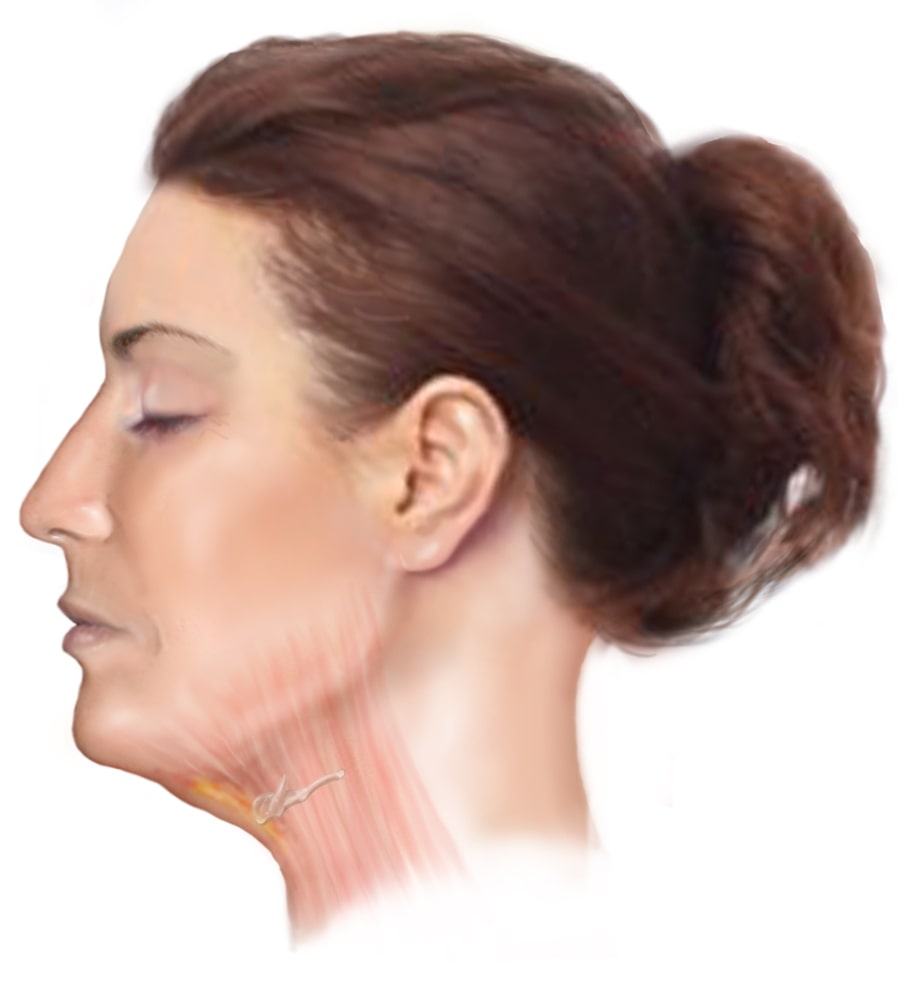
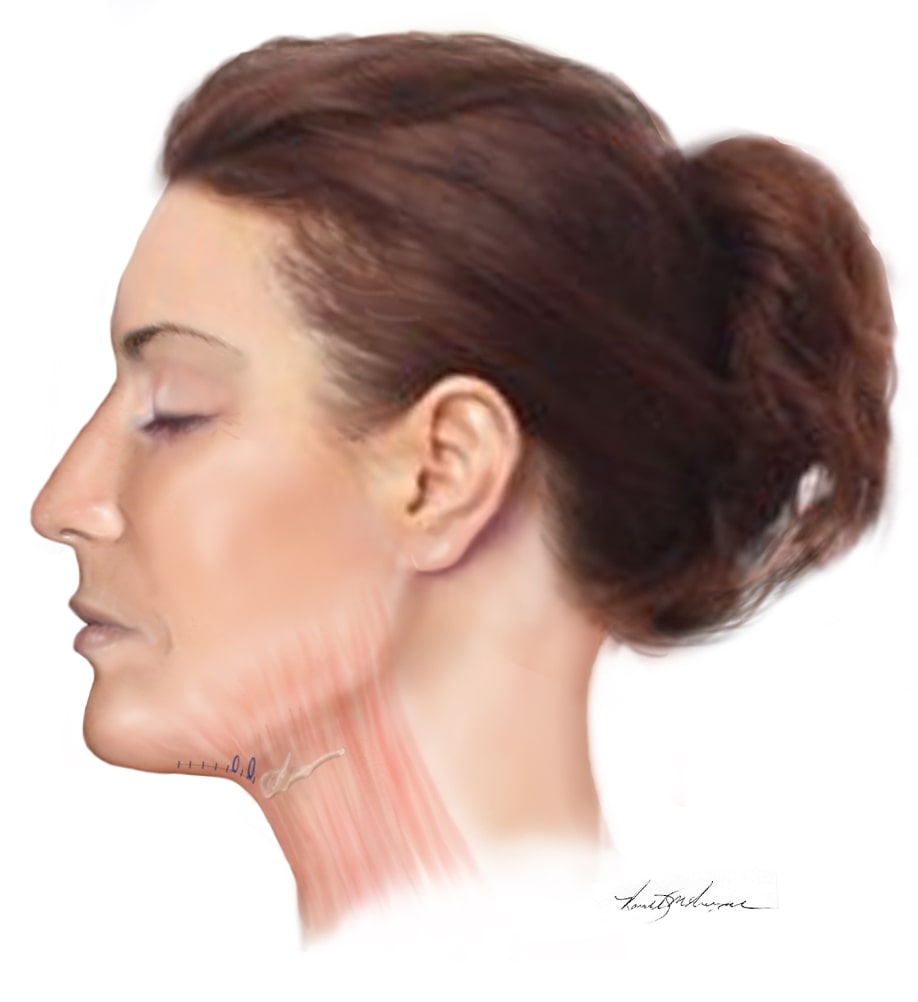
Through an incision placed in a natural crease beneath the chin, the deeper neck structures can be accessed. The surgeon may carefully remove fat beneath the platysma when it contributes to fullness. This exposes the deeper muscular anatomy and gives the surgeon room to reshape the neck from within.
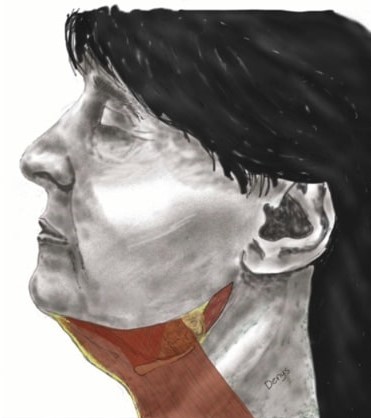
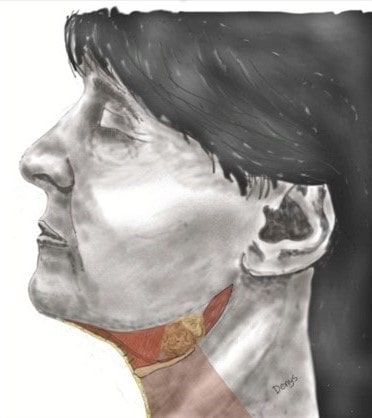
The platysma is then mobilized toward the center of the neck. Depending on the patient’s anatomy, the digastric muscles may also be addressed. The muscle complex can then be suspended to deeper, stable tissues around the mylohyoid region.
This medialization and suspension creates additional support directly beneath the chin rather than relying on skin tension to hold the new contour.
Dr. Langsdon’s published description of SMMS specifically addresses the medialization and suspension of the platysma and, when anatomy requires it, the anterior digastric muscles to the deeper mylohyoid structure.
When SMMS is combined with an upper deep plane facelift, the deeper tissues of the cheek and jowl can be repositioned while the deeper structures of the neck are treated below. This allows the facial and neck rejuvenation to work together rather than treating the jawline as an isolated boundary between two separate procedures.
How Is SMMS Different from a Traditional Neck Lift or Platysmaplasty?
The difference is primarily how deep the surgery goes and which anatomical structures are repositioned.
A traditional neck lift may remove superficial fat, tighten the platysma, remove excess skin, or combine these approaches. A corset platysmaplasty commonly brings the medial edges of the platysma together under the chin.
For many necks, that is enough.
SMMS is intended for selected patients in whom deeper anatomy contributes to the lack of neck definition. The procedure permits treatment beneath the platysma, including deeper fat and muscular structures that a more superficial neck treatment does not address in the same way.
Rather than simply creating more tension, the procedure changes the structural relationship of tissues beneath the chin.
That distinction is particularly important for a naturally heavy neck or an obtuse cervicomental angle.
How Does SMMS Work with a Deep Plane Facelift?
A deep plane facelift repositions deeper facial tissues rather than creating most of the lift by pulling on the skin.
The tissues are released and elevated more vertically, helping improve the cheek, jowl, and jawline while allowing the skin to redrape over the repositioned structures with less tension.
This can create excellent facial and jawline improvement, but the deep plane facelift alone cannot overcome every type of neck anatomy.
When a patient has deeper fullness or a naturally blunt neckline, SMMS can be added to address the structures beneath the chin while the deep plane component restores the face and jowls above it.
The result is a more comprehensive treatment of the cheek-jowl-neck relationship, rather than attempting to create jawline definition by pulling the tissues backward.
Can SMMS Create a More Defined Jawline?
For appropriately selected patients, improving the neck angle can make the jawline substantially more visible.
A jawline can appear poorly defined even when the jaw itself is structurally strong because fullness beneath it obscures the border between the face and neck. SMMS works below that border.
By reducing deep fullness and repositioning the muscular support beneath the chin, the procedure can expose and enhance the natural line of the jaw rather than attempting to manufacture definition through skin tension alone.
If a weak or recessed chin is also contributing to the profile, chin augmentation may sometimes be considered along with facelift and neck surgery.
Who Is a Good Candidate for an SMMS Facelift?
SMMS is not necessary for every facelift patient. It is most relevant when deeper neck anatomy limits the improvement that would be expected from a more conservative neck treatment.
A potential candidate may have a naturally full or heavy neck, a blunt chin-to-neck angle, deeper fullness beneath the platysma, sagging through the jowls and neck, or a neckline that has never been particularly sharp even at a lower body weight. It may also be considered when the anatomy of the platysma, digastric region, or other deeper structures contributes significantly to the patient’s profile.
During consultation, the surgeon determines whether the problem is primarily skin, superficial fat, deeper fat, muscle position, chin projection, skeletal anatomy, or a combination of factors.
A more extensive technique should only be used when it offers a meaningful anatomical advantage. The Langsdon Clinic takes a patient-focused approach by listening carefully to concerns, discussing available options, explaining potential risks and complications, and recommending the treatment best suited to the individual.
Why Can SMMS Produce a Natural-Looking Result?
A natural facelift is not simply one that makes a patient look younger. It should improve aging without creating obvious tension through the skin.
SMMS places the major structural work beneath the surface.
When deeper tissues provide the support, the overlying skin can be redraped rather than stretched tightly to create the contour. This helps reduce the need to make the skin itself carry the tension of the lift, one of the factors associated with an overly pulled or windswept appearance.
The same philosophy applies to the deep plane portion of the facelift. The deeper tissue is repositioned first; the skin follows.
No technique can stop aging or permanently prevent tissues from stretching over time. What SMMS offers is a different structural approach for patients whose neck anatomy calls for deeper correction.
Does SMMS Provide Longer-Lasting Neck Lift Results?
SMMS is designed to create strong structural support by securing the treated muscular tissues to deeper anatomical structures rather than relying primarily on skin tension. This can provide a more substantial foundation for the neck contour in appropriately selected patients.
However, no facelift technique stops the biological aging process. Skin continues to lose elasticity, tissues continue to change, and genetics, weight changes, sun exposure, smoking, and overall health can all influence the appearance of the face and neck over time.
The advantage of SMMS is not that aging stops. It is that deeper contributors to neck laxity and fullness can be addressed rather than asking the skin alone to compensate for them.
What Research Has Been Published on the SMMS Technique?
One thing that distinguishes SMMS from a marketing name created for a familiar facelift maneuver is that Dr. Langsdon has published the surgical technique and its outcomes in peer-reviewed medical literature.
A 2013 article in Aesthetic Surgery Journal described the technique and reviewed patients who underwent SMMS alone or in conjunction with facelift surgery. The procedure involved medialization and suspension of the platysma and, when indicated, the digastric muscles to the deeper mylohyoid structure.
A later study published in JAMA Facial Plastic Surgery evaluated facelift patients and compared SMMS with traditional rhytidectomy using platysmaplasty. The study found greater mean improvement in cervical point distance among the SMMS patients, supporting the procedure as an option for selected patients with an obtuse neck angle.
Dr. Langsdon has spent decades developing, measuring, publishing, teaching, and refining this procedure.
What Happens During a Deep Plane Facelift With SMMS?
A deep plane facelift with SMMS is performed at The Langsdon Clinic’s on-site, Tennessee-licensed surgical facility in Germantown.
For facial procedures, deep IV sedation is generally used, similar to sedation used during a colonoscopy. The patient is fully monitored by anesthesia personnel and is unaware of the surgery while breathing without mechanical ventilation.
Facelift incisions are placed around the natural contours of the ears and hairline, as appropriate. A separate incision beneath the chin provides access to the deeper neck.
The exact procedure depends on the patient’s anatomy. The deep plane portion addresses the descended tissues of the face and jowls, while the SMMS component may include removal of deep fat, mobilization of the platysma and other muscular structures, medialization, and suspension to improve the neck angle.
Once the deeper work is complete, the skin is re-draped, and excess skin can be removed without relying on excessive skin tension to create the lift.
What Is Recovery Like After an SMMS Facelift?
Patients should expect swelling and bruising during the early recovery period. Most patients at The Langsdon Clinic report relatively little discomfort, although medication is available when needed.
Patients generally rest during the first week, avoid strenuous activity during the initial healing period, and keep the head elevated for approximately two weeks. Many patients begin returning to office work and normal social activities at around two weeks, although the exact timeline depends on the extent of surgery and the individual’s healing.
The Langsdon Clinic also emphasizes communication during recovery. The team communicates with the patient’s caregiver during the first night after surgery, evaluates the patient the following day, and then remains in close contact through office visits, photographs, or phone conversations throughout the first week.
Patients are generally seen again around week two and periodically thereafter until healing is complete.
Why Choose The Langsdon Clinic for SMMS and Deep Plane Facelift Surgery?
Dr. Phillip R. Langsdon
Dr. Phillip R. Langsdon is board-certified by the American Board of Facial Plastic and Reconstructive Surgery and has spent more than 25 years in a practice focused on cosmetic surgery of the face, nose, eyes, head, and neck.
He developed and refined the SMMS technique, published his methods and results, and has seen elements of his approach adopted by other facelift surgeons. He also served as President of the American Academy of Facial Plastic and Reconstructive Surgery in 2018–2019 and has been extensively involved in facial plastic surgery education.
For patients researching advanced neck lift surgery, that distinction matters. SMMS is not simply another service offered at The Langsdon Clinic. It represents work that originated within the practice and contributed to the broader surgical discussion of how difficult neck contours can be treated.
The Langsdon Clinic’s reach extends well beyond Memphis. Patients seek out the practice from across the United States and internationally for advanced facial plastic surgery, with deep plane facelift and rhinoplasty representing central areas of expertise.
Dr. Sarah Langsdon
Dr. Sarah E. Langsdon adds another generation of advanced facial aesthetic surgery training to the practice.
A Memphis native, she earned her medical degree from the University of Tennessee Health Science Center before completing a six-year integrated plastic surgery residency at the University of Missouri. She then completed an additional yearlong fellowship specializing in facial aesthetic surgery. Her current clinical focus includes deep plane facelift and rhinoplasty.
Her approach reflects the practice’s emphasis on careful communication and individualized results. Rather than treating facial rejuvenation as a standardized procedure, The Langsdon Clinic evaluates the anatomy, concerns, realistic options, risks, and potential need for additional treatment with each patient.
Together, Drs. Phillip and Sarah Langsdon give The Langsdon Clinic a depth of facial rejuvenation experience that combines decades of surgical innovation with contemporary advanced training.
Traveling to Memphis for SMMS or Deep Plane Facelift Surgery
The Langsdon Clinic’s facelift practice is not limited to Memphis-area patients. The practice welcomes patients seeking specialized facial plastic surgery from across the United States and around the world.
Seeking advanced facelift specialization from outside Tennessee? Contact The Langsdon Clinic to learn more about our virtual consultation process and travel planning options for out-of-state and international patients.
Our practice’s freestanding Germantown location includes an on-site, Tennessee-licensed surgical facility for facial plastic surgery, allowing consultation, surgery, and early postoperative care to remain closely connected.
Schedule an SMMS Facelift Consultation in Memphis
Contact The Langsdon Clinic today to schedule a consultation with Dr. Langsdon. Patients travel from throughout the Mid-South and across the U.S. to see Dr. Langsdon because he is widely recognized as one of the best facelift and rhinoplasty surgeons in the nation.
For more information on your facial plastic surgery in or around the Memphis, TN area, please contact us by calling 888-816-FACE (3223) or 901-755-6465, or by sending us a message on our website. Dr. Langsdon and his team look forward to helping you discover the excellent results possible through facial rejuvenation!
SMMS Facelift FAQs
No. A deep plane facelift primarily repositions deeper facial tissues through the cheeks, jowls, and lower face. SMMS specifically addresses deeper structures beneath the chin and in the upper neck. The techniques may be combined when a patient needs improvement in both areas.
Traditional platysmaplasty commonly tightens or brings together the platysma muscles beneath the chin. SMMS can go deeper, addressing subplatysmal fullness and repositioning muscular structures before securing them to deeper tissue. Which approach is appropriate depends on the patient’s anatomy.
It can. When subplatysmal fat contributes to neck fullness, it may be carefully removed as part of the SMMS procedure. The amount of fat treatment depends on the individual’s anatomy.
Not for everyone. Many patients can achieve excellent improvement with a more conservative neck treatment. SMMS is intended for selected patients whose deeper anatomy makes additional structural correction useful.
Potentially. Some patients have a full or poorly defined neckline because of inherited anatomy rather than aging or weight gain alone. SMMS allows the surgeon to address deeper structures that may contribute to this appearance.
Yes. If limited chin projection contributes to a weak chin-to-neck relationship, chin augmentation may be considered along with SMMS and facelift surgery.
SMMS and deep plane facelift techniques place much of the structural correction in deeper tissue layers rather than depending on excessive skin tension. The skin can then be redraped over the repositioned tissues, which is intended to support a more natural appearance.
Many patients plan for approximately two weeks before returning comfortably to office work and more visible social activities, although recovery varies. Swelling continues to improve after that period, and complete surgical healing takes considerably longer.
The Langsdon Clinic is located in Germantown in the greater Memphis area, but the practice also welcomes patients traveling from outside the region. Patients coming from another state or country can contact the clinic to discuss consultation, travel, surgery, and follow-up planning.