
Neck Lift in Memphis, TN
Loose skin, fullness under the chin, visible neck bands, and a less defined jawline can change the shape of the lower face over time. Aging is a common cause, but genetics, sun exposure, and significant weight changes can also affect neck contour.
A neck lift is a surgical procedure that improves these changes by addressing loose skin, excess fat, and weakened or separated underlying muscles. The procedure can create a smoother transition from the jawline to the neck and restore definition that has been lost with age or weight fluctuation.
At The Langsdon Clinic in Germantown, Dr. Phillip R. Langsdon and Dr. Sarah E. Langsdon perform facial and neck rejuvenation with careful attention to the deeper structures that determine contour.
Dr. Phillip Langsdon is a board-certified facial plastic surgeon and former President of the American Academy of Facial Plastic and Reconstructive Surgery. Dr. Sarah Langsdon completed a six-year integrated plastic surgery residency at the University of Missouri followed by additional fellowship training in facial aesthetic surgery.
Call (901) 755-6465 to schedule a consultation at The Langsdon Clinic to discuss your options. During your visit, you’ll learn what the procedure involves and what a neck lift can accomplish.
Quick Links:
- What Is a Neck Lift?
- Why Does the Neck Lose Definition with Age?
- What Can Neck Lift Surgery Improve?
- Who Is a Good Candidate for a Neck Lift?
- How Is a Neck Lift Performed?
- What Role Does the Platysma Muscle Play in a Neck Lift?
- Can a Neck Lift Improve a Double Chin?
- Can a Neck Lift Sharpen the Jawline?
- What Is the Difference Between a Neck Lift and a Facelift?
- Can a Neck Lift Be Performed After Weight Loss?
- Can a Neck Lift Be Combined with Other Facial Procedures?
- What Is Recovery Like After a Neck Lift?
- When Will I See My Neck Lift Results?
- How Long Do Neck Lift Results Last?
- Why Choose The Langsdon Clinic for Neck Lift Surgery?
- Schedule a Neck Lift Consultation in Memphis
- Memphis Neck Lift FAQs
What Is a Neck Lift?
A neck lift reshapes aging or lax tissues beneath the chin, along the jawline, and through the neck.
The operation can involve several surgical steps depending on the anatomy involved. Loose skin may be repositioned, excess fat may be removed, and the underlying neck muscles may be tightened or supported to create a cleaner contour.
Common concerns treated with neck lift surgery include:
- Loose or hanging neck skin
- A poorly defined jawline
- Fullness beneath the chin
- Visible vertical neck bands
- Muscle laxity
- A heavy or poorly defined neck contour
- Changes following significant weight loss
- Age-related softening between the chin and neck
A consultation lets your neck lift surgeon identify which tissues are causing the concern and determine how much correction is appropriate.
Why Does the Neck Lose Definition with Age?
A youthful-looking neck has a relatively smooth contour from the jawline toward the base of the neck.
Several anatomical changes can gradually obscure that definition:
- Skin becomes thinner and loses elasticity.
- Fat can accumulate or shift beneath the chin.
- The platysma, a broad sheet of muscle extending across the neck, can loosen and separate with age.
- Deeper fat and other structures may also contribute to fullness in certain patients.
These changes can soften the angle beneath the chin and make the jawline appear less distinct.
Genetics also have a considerable influence. A heavy neck, limited chin projection, low-positioned neck structures, or a tendency to store fat beneath the chin may be present long before significant facial aging occurs.
What Can Neck Lift Surgery Improve?
Neck lift surgery can improve several areas at once when they contribute to an aged or heavy appearance.
Loose Neck Skin
Skin that has lost elasticity can gather beneath the chin or along the front of the neck. During surgery, the tissues can be repositioned and excess skin removed through carefully placed incisions.
Neck Bands
Vertical bands may become visible as the platysma muscle loosens with age. Surgical tightening or repositioning of the muscle can create a smoother contour.
Fullness Beneath the Chin
Excess fat can obscure the angle between the chin and neck. Fat may be removed during a neck lift when it is contributing to the problem.
Jawline Definition
Lax skin and underlying tissues can blur the lower border of the jaw. Repositioning these tissues can improve the transition between the face and neck.
Changes After Weight Loss
Significant weight loss may leave excess skin even after the underlying fullness has decreased. A neck lift can remove and reposition this tissue when the skin does not contract sufficiently on its own.
Who Is a Good Candidate for a Neck Lift?
Many neck lift patients are in their 40s through 70s, although age alone does not determine candidacy.
Younger adults may consider surgery after substantial weight loss or when hereditary anatomy creates significant fullness or loose skin beneath the chin.
Good candidates are generally healthy, have realistic expectations, and have enough skin and tissue quality to support appropriate healing.
A neck lift may be worth considering when:
- Loose skin is creating a sagging appearance
- The jawline has become less defined
- Neck bands have become more visible
- Fullness beneath the chin remains despite weight management
- Weight loss has left excess skin
- The neck looks older than the rest of the face
Dr. Phillip Langsdon or Dr. Sarah Langsdon evaluates the skin, muscle, fat distribution, jawline, chin, and deeper neck anatomy before recommending treatment.
How Is a Neck Lift Performed?
The surgical plan is based on the specific anatomy contributing to the patient’s neck contour. With decades of experience in facial and neck rejuvenation, Dr. Phillip Langsdon evaluates the skin, fat, platysma muscle, and deeper supporting structures to determine where correction can make a meaningful difference.
Incisions are carefully placed beneath the chin and, when needed, around the ears so they can be concealed within natural creases and contours. Through these access points, Dr. Langsdon can address the underlying tissues directly, refining the neck from its deeper structure outward rather than relying on skin tightening alone.
Depending on the surgical plan, a neck lift may involve:
- Removing excess fat beneath the chin
- Tightening or repositioning the platysma muscle
- Bringing separated neck muscles together beneath the chin
- Repositioning deeper tissues
- Redraping loose neck skin
- Removing excess skin
- Improving the contour beneath the jaw
- Strengthening support throughout the lower face and neck
The amount of surgery required varies considerably with anatomy. A neck affected primarily by skin laxity requires a different approach from one with significant muscle separation, submental fullness, or deeper structural concerns.
What Role Does the Platysma Muscle Play in a Neck Lift?
The platysma is a thin, broad muscle that extends across the front and sides of the neck.
As its support weakens, the edges of the muscle may separate or become more visible, creating vertical bands and reducing definition beneath the chin.
During neck lift surgery, your surgeon can tighten, reposition, or secure the platysma to improve the neck’s underlying support. This part of the operation can be particularly important when muscle laxity contributes heavily to the patient’s appearance.
Correcting the deeper support helps the new neck contour rely less on tension on the skin.
Can a Neck Lift Improve a Double Chin?
A neck lift may improve fullness beneath the chin when excess fat and loose tissue contribute to the appearance.
The surgeon can remove excess fat as part of the operation while also addressing skin and muscle laxity.
A double chin is not always caused by fat alone. Chin projection, muscle anatomy, skin elasticity, and deeper neck structures can all affect the angle beneath the jaw. Evaluating these factors before surgery helps determine which correction is appropriate.
Can a Neck Lift Sharpen the Jawline?
Yes. Improving jawline definition is one of the major benefits of neck rejuvenation.
Loose skin and weakened tissues can obscure the lower border of the jaw and create a continuous line between the face and neck. Repositioning these tissues can restore clearer separation between the two areas.
The result depends on the patient’s bone structure, chin projection, skin quality, and underlying anatomy. We evaluate these factors during consultation so that the surgical plan reflects the contours of the individual face.
What Is the Difference Between a Neck Lift and a Facelift?
A neck lift concentrates on the tissues beneath the jaw and through the neck. A facelift addresses aging in the lower and mid-face, along with the jawline and, depending on the technique, portions of the neck.
Neck lift surgery may be appropriate when the face still has good definition, but the neck has developed loose skin, fullness, or muscle laxity.
When aging extends through the cheeks, jowls, jawline, and neck, treating the areas together may provide better continuity across the lower face.
Dr. Phillip or Dr. Sarah Langsdon can determine how much of the face and neck needs to be addressed after examining the pattern of aging.
Can a Neck Lift Be Performed After Weight Loss?
Yes. Significant weight loss can leave loose skin around the jaw and neck even when the excess fat is gone.
Skin with good elasticity may tighten to some degree after weight stabilizes, but more substantial laxity often remains.
During a neck lift, excess skin can be removed, and the remaining tissues repositioned to better follow the underlying jaw and neck structure.
Patients considering surgery after major weight loss should generally be at or near a stable weight before proceeding.
Can a Neck Lift Be Combined with Other Facial Procedures?
Yes. Because aging often affects the lower face and neck together, a neck lift may be combined with other procedures when broader facial rejuvenation is appropriate.
Procedures that may be performed with neck surgery include:
- Facelift
- Deep Plane Facelift
- Blepharoplasty (Eyelid Surgery)
- Brow Lift
- Chin Augmentation
- Facial fat reduction or contouring when appropriate
- Laser Skin Resurfacing
- Chemical Peels
Dr. Phillip Langsdon and Dr. Sarah Langsdon can evaluate the face and neck together to determine whether combining procedures would provide a more complete, balanced improvement.
Request a Consultation
If you have any questions or wish to schedule a personalized consultation with Dr. Langsdon, please contact our office.
What Is Recovery Like After a Neck Lift?
Neck tissues need time to heal and stabilize after surgery.
A general recovery timeline may include:
- First few days: Expect swelling, tightness, and mild bruising. Rest is important, and keep your head and neck in the position your surgical team recommends.
- First two weeks: Avoid excessive neck movement and vigorous activity. The Langsdon Clinic specifically advises patients to limit repeated side-to-side head turning for approximately 14 days so the repositioned tissues can heal properly.
- After two weeks: Swelling and bruising generally continue to decrease, and patients gradually return to more normal daily activity as directed by their surgeon.
- In the following weeks and months: Residual swelling continues to resolve, incision lines mature, and the neck contour becomes increasingly defined.
Healing varies according to the extent of surgery and whether other facial procedures were performed at the same time.
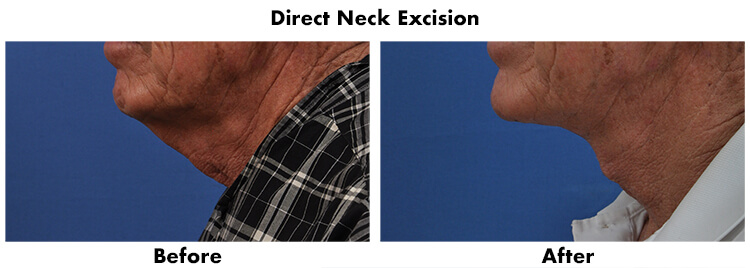
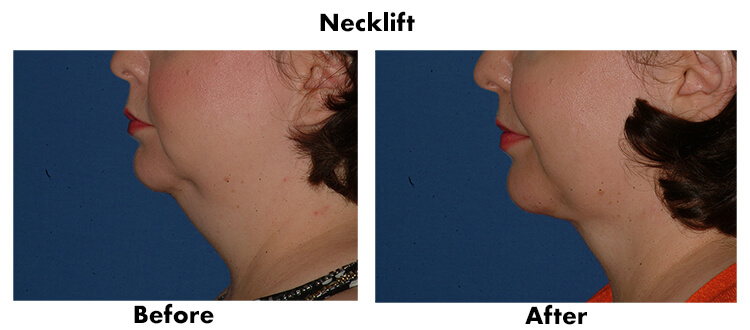
Neck Lift Before and After Photos
When Will I See My Neck Lift Results?
Improvement in neck and jawline contour becomes apparent as the early swelling subsides.
You can usually see initial changes relatively soon, but the tissues continue settling over the following weeks and months. Swelling gradually decreases, incisions soften, and the neck takes on a more natural contour as healing progresses.
The final result reflects the deeper changes made during surgery as well as the way the skin contracts and adapts to the new underlying structure.
How Long Do Neck Lift Results Last?
A neck lift produces long-lasting structural improvement, although the neck continues to age naturally after surgery.
Skin quality, genetics, weight changes, sun exposure, smoking, and the extent of the original correction influence the durability of the result.
Maintaining a stable weight and protecting the skin from excessive sun exposure can help preserve the neck’s appearance over time.
Why Choose The Langsdon Clinic for Neck Lift Surgery?
Phillip R. Langsdon, M.D.
Dr. Phillip R. Langsdon is a board-certified facial plastic surgeon whose practice has been devoted to cosmetic surgery of the face, nose, eyes, head, and neck.
A former President of the American Academy of Facial Plastic and Reconstructive Surgery, Dr. Langsdon has spent decades performing facial rejuvenation surgery, publishing surgical techniques, and participating in advanced physician education.
His work in facial and neck surgery includes techniques designed to improve deeper muscular support as well as visible skin and soft-tissue laxity.
Sarah E. Langsdon, M.D.
Dr. Sarah E. Langsdon completed a six-year integrated plastic surgery residency at the University of Missouri followed by additional fellowship training specializing in facial aesthetic surgery.
Her training includes advanced facial rejuvenation and provides a comprehensive understanding of the skin, fat, muscle, and structural relationships that shape the lower face and neck.
Together, Drs. Phillip and Sarah Langsdon evaluate the face and neck as a connected anatomical unit and tailor treatment to the pattern of aging present in each patient.
Schedule a Neck Lift Consultation in Memphis
At The Langsdon Clinic, Dr. Phillip Langsdon and Dr. Sarah Langsdon bring extensive training in facial and neck rejuvenation to every consultation. They take time to evaluate the skin, fat, muscle, jawline, and deeper neck anatomy, then explain which changes are realistically achievable and which surgical approach fits your goals.
That level of detail matters. A well-planned neck lift should improve contour while preserving a natural relationship between the face, jawline, and neck.
Schedule a private consultation at The Langsdon Clinic in Germantown to discuss neck lift surgery with a team known for advanced facial plastic surgery, individualized care, and natural-looking results, or call (901) 755-6465.
Memphis Neck Lift FAQ
Yes, we are one of the top providers of neck liposuction in Memphis. Neck lipo removes excess fat to help sculpt a more defined jawline. Neck liposuction is an excellent option for those who have significant excess fat underneath the chin, whereas a neck lift serves those with lax skin and underlying tissues, often referred to as a turkey neck.
Patients frequently pair multiple procedures to receive the best results. Dr. Langsdon is an expert in SML neck lifts, SML liposuction, and many other neck contouring methods. Additionally, you can also choose to add other procedures of the upper face, such as a brow lift, eyelid lift, or facelift. Combining procedures needs to be reviewed on a case by case basis to ensure the best results. Dr. Langsdon will help you decide which Memphis neck plastic surgery method is right for you in your consultation.
Typically, Dr. Langsdon will create your incisions underneath the chin and behind the ears. After completing the surgery, he will carefully close them to ensure the best chance of adequate healing. The majority of patients report that their scars heal very well and are almost entirely unnoticeable.
There is no single “best” neck-tightening procedure for everyone. What matters is making the right choice for you. In your consultation with Dr. Langsdon, he will examine you and ask about the changes you hope to make. He’ll then advise you on the safest and most effective treatment for your unique needs. Neck lift surgery is generally the recommended option to correct significant skin and muscle laxity below the chin and on the neck. For less advanced issues, non-surgical skin tightening procedures may be a better decision. If your dissatisfaction with your neck’s appearance relates to excess fat and you have sufficient skin resilience, liposuction might be a good choice. If looseness and sagging are noticeable below your jawline and on your face, Dr. Langsdon might recommend combining a neck lift with a lower facelift.
Dr. Langsdon uses either local or general anesthesia when performing neck lift surgery, so patients experience no pain during the procedure. In the first few days of recovery, you can expect to experience some tightness, tingling, or numbing, which may be uncomfortable. You can manage any soreness with non-prescription pain medication.
Neck lift surgery addresses the hanging skin that can develop below the jawline by trimming the excess and pulling the remaining skin upward, toward the ears. You can get a sense of this effect by placing your fingers in front of your ears and gently pushing your skin up. If you struggle with age-related issues in the lower third of your face, you may benefit from a combined facelift and neck lift.
Many people begin experiencing skin and muscle laxity in their late 30s or early 40s. But there’s no fixed timeline for this natural aging process. In some people, the loosening begins sooner and advances quickly. In others, it starts later and progresses so slowly that it never becomes a cosmetic concern. Genetics, weight changes, smoking, sun exposure, and diet are all factors.
Yes. Dr. Langsdon performs all his cosmetic procedures for attractive and natural-looking results. The changes made with a neck lift leave patients looking subtly younger and more energetic without suggesting that they’ve had surgery. See for yourself in Dr. Langsdon’s before-and-after gallery.
A neck lift specifically targets skin, fat, and muscle laxity below the jawline for a more youthful appearance. You may wish to pair your neck lift with a facelift for a more comprehensive rejuvenation.
Yes, a neck lift can create a more defined and contoured jawline by reducing the appearance of a double chin. Removing excess fat with liposuction will ensure optimal results.
Recovery time can vary, but most patients feel well enough to return to a desk job and light exercise one to two weeks after a neck lift. However, please avoid strenuous workouts, heavy lifting, and anything else that could result in excess neck movement or muscle strain for at least four weeks to ensure proper healing.
A neck lift can dramatically improve your appearance by addressing signs of aging like loose skin and excess fat. While it won’t stop the aging process, you will look younger and more vibrant than others in your age group who did not have this procedure.
Dr. Langsdon usually recommends general anesthesia to ensure his neck lift patients sleep comfortably through the procedure. If you think you would prefer local anesthesia with sedation, please ask about this during your consultation.
Non-surgical skin tightening procedures are available for people experiencing a less advanced degree of aging. While these alternatives can provide a temporary improvement, they are not as effective or long-lasting as a surgical neck lift for addressing issues like sagging skin and muscle banding.
A healthy lifestyle and consistent skin care routine are the best ways to look younger for longer. Avoid excessive sun exposure, stay hydrated, and use medical-grade products to keep your face and neck clean and moisturized. Regular exercise and maintaining a stable weight can preserve your neck’s youthful contour. Additionally, follow Dr. Langsdon’s postoperative care instructions for optimal healing and long-lasting results.
As with any surgical procedure, a neck lift carries some potential risks, such as infection, bleeding, scarring, and adverse reactions to anesthesia. Other possible complications include nerve injury, hematoma, and unsatisfactory results. Choosing a board-certified, highly experienced surgeon will decrease the likelihood of problems and ensure your safety.
Dr. Langsdon’s pre-operative instructions may include avoiding specific medications and supplements, quitting smoking, and arranging for transportation and aftercare. Stay hydrated, eat a balanced diet, and get plenty of rest in the weeks leading up to your surgery. Stocking up on essentials like comfortable clothing and premade meals can also make your recovery smoother.